
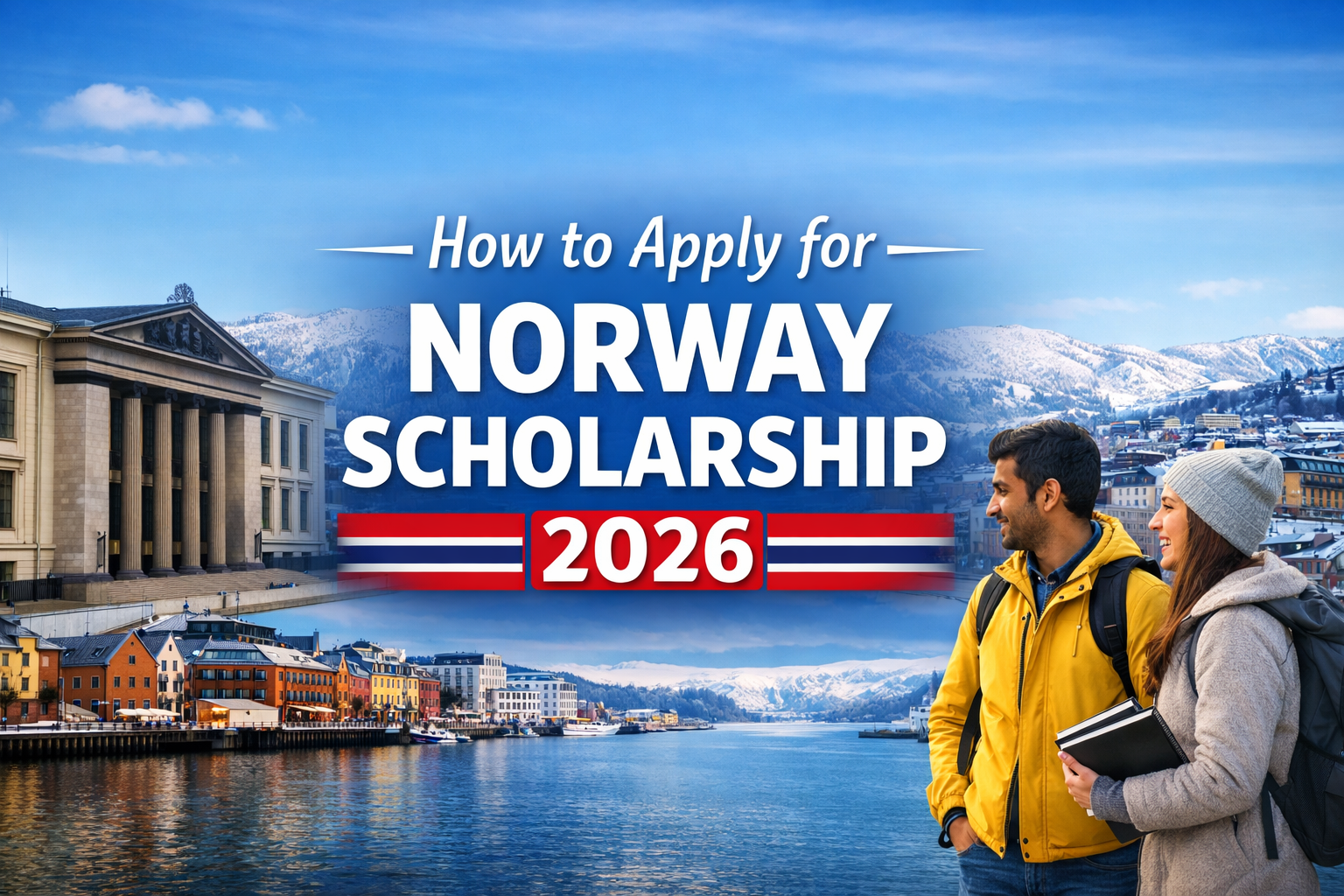
In a year marked by rising tuition costs and limited international study options, a new wave of fully funded opportunities from Norway has captured the attention of Pakistani students. The Norway Scholarship 2026 cycle opens doors to tuition-free education, transparent admission systems, and a globally respected academic environment without the burden of excessive fees.
This timely development answers urgent questions for students asking who can apply, what programs qualify, when applications open, where to apply, and why Norway continues to rank among the most student-friendly destinations in Europe.
Understanding Norway Scholarships 2026: The Big Picture
Norway’s public education model stands apart. For decades, the country has invested heavily in human capital, offering education as a public good rather than a commercial service. As a result, international students—including Pakistanis can access free education in Norway at public universities, even at the master’s and PhD levels.
The 2026 scholarship landscape reflects policy updates introduced after 2023, where living cost requirements became more structured but tuition at public institutions remained free. This balance ensures academic accessibility while maintaining sustainability.
Why Norway Matters for Pakistani Students in 2026
Pakistani students face increasing competition for funded programs worldwide. Norway offers a rare combination of academic excellence, transparent admissions, and tuition-free public universities. For families in Pakistan, this model reduces long-term financial risk.
The appeal goes beyond cost. Norway consistently ranks high for safety, quality of life, research output, and graduate employability. Degrees from Norwegian universities hold strong recognition across Europe and beyond.
Most importantly, free education in Norway aligns with the growing demand among Pakistani students for merit-based, corruption-free academic systems.
Who Can Apply for Norway Scholarships 2026
Eligibility remains broad but structured. Pakistani applicants must meet academic, language, and documentation standards. Generally, applicants fall into three categories:
Undergraduate Applicants
- Completion of Higher Secondary School Certificate (HSSC)
- Strong academic record
- English proficiency proof (IELTS or equivalent)
Master’s Degree Applicants
- Four-year bachelor’s degree or equivalent
- Relevant academic background
- IELTS score typically 6.5 or higher
PhD Applicants
- Master’s degree in a related field
- Research proposal
- Supervisor acceptance from a Norwegian university
Norway does not discriminate by nationality, religion, or gender, making the system particularly inclusive for Pakistani students.
What Types of Scholarships Are Available
Norway does not operate under a single centralized scholarship brand. Instead, funding comes through multiple channels:
Tuition-Free Public Universities
Most public universities in Norway charge no tuition fees. This alone qualifies as free education in Norway, though students must cover living expenses.
Erasmus+ and Nordic Programs
Some master’s programs fall under Erasmus Mundus or Nordic cooperation schemes, offering monthly stipends.
University-Specific Scholarships
Certain universities provide partial grants, housing support, or research assistantships.
Research Council of Norway Funding
PhD candidates often receive salaried positions funded by national research bodies.
When to Apply: Key Deadlines for 2026 Intake
Timing matters. Norwegian universities follow strict deadlines:
- October–December 2025: Master’s program applications open
- December 1 – January 15: Main application deadlines
- February–March 2026: Admission results released
- August 2026: Semester begins
Applicants must prepare documents at least six months in advance to avoid last-minute issues.
Where to Apply: Official Platforms Only
All applications go through official university portals. Norway maintains a decentralized system, meaning each institution manages its own admissions.
Students should avoid agents claiming guaranteed placement. Norwegian universities do not authorize third-party admission guarantees. Trust-based systems define the Norwegian model, reinforcing the credibility of free education in Norway.
How to Apply for Norway Scholarship 2026: Step-by-Step Guide
Understanding How to apply for Norway scholarship 2026 requires attention to detail and strict compliance with instructions.
Step 1: Shortlist Programs
Research programs taught in English. Focus on relevance to your academic background.
Step 2: Check Entry Requirements
Each program lists GPA thresholds, language scores, and prerequisites.
Step 3: Prepare Documents
Required documents typically include:
- Academic transcripts
- Degree certificates
- Passport copy
- Statement of purpose
- Letters of recommendation
- IELTS or equivalent
Step 4: Submit Online Application
Upload documents through the university portal before the deadline.
Step 5: Await Decision
Admission decisions arrive via email or portal updates.
This structured process ensures fairness and transparency—key strengths of free education in Norway.
Cost of Living in Norway: What Students Must Know
While tuition remains free at public institutions, living costs in Norway are among the highest in Europe. Students must show proof of funds, usually around NOK 137,000 per year.
Monthly expenses include:
- Accommodation
- Food
- Transport
- Health insurance
Despite higher costs, part-time work opportunities help students manage expenses legally during studies.
Work Opportunities During and After Studies
International students can work up to 20 hours per week during semesters and full-time during holidays. After graduation, Norway offers post-study work options under skilled worker permits.
This pathway allows Pakistani graduates to gain European work experience, increasing long-term return on investment—even with free education in Norway as the foundation.
Fields of Study in High Demand
Norway prioritizes research and innovation. Popular fields include:
- Computer Science and IT
- Renewable Energy
- Environmental Sciences
- Engineering
- Public Health
- Business Analytics
These programs align with global labor market needs, strengthening employability.
Language Requirements Explained
Most international programs use English as the medium of instruction. IELTS remains the most accepted test.
Typical requirements:
- IELTS Academic 6.5 overall
- No band below 6.0
Some universities accept alternative proof if prior education was in English.
Visa Process for Pakistani Students
After receiving admission, students apply for a study residence permit. Required documents include:
- Admission letter
- Proof of funds
- Accommodation details
- Passport
The Norwegian visa process emphasizes documentation accuracy and transparency.
Why Norway Maintains Tuition-Free Education
Norway’s model reflects long-term national strategy. Education supports innovation, equality, and global cooperation. By welcoming international students, Norway strengthens research diversity and cultural exchange.
For Pakistanis, this policy translates into rare access to free education in Norway without hidden costs or political barriers.
Common Mistakes to Avoid
Many applicants fail due to avoidable errors:
- Missing deadlines
- Incomplete documents
- Unverified transcripts
- Generic statements of purpose
Attention to detail separates successful applicants from rejected ones.
Role of Chal Pakistan in Student Guidance
Chal Pakistan operates as an independent information platform, offering verified guidance, application timelines, and policy updates. Based in Lahore, the organization focuses on clarity, trust, and student empowerment rather than false promises.
Norway vs Other European Destinations
Compared to Germany, Sweden, or Finland, Norway remains unique. While others have introduced tuition fees or limited scholarships, Norway preserves its tuition-free public education model.
This consistency reinforces Norway’s position as a stable destination for Pakistani students seeking long-term academic value.
Future Outlook: Norway Scholarships Beyond 2026
Policy signals suggest Norway will maintain tuition-free public education with structured living cost requirements. Demand from South Asia continues to rise, making early preparation essential.
Students planning ahead gain a competitive advantage in accessing free education in Norway.
Final Thoughts on How to Apply for Norway Scholarship 2026
Success depends on preparation, honesty, and timely action. Norway rewards merit, not connections. For Pakistani students willing to meet academic standards and plan responsibly, the 2026 intake represents a realistic, high-value opportunity.
Read Trusted Stories, Breaking News & In-Depth Blogs – Start Exploring ChalPakistan
Frequently Asked Questions (FAQs)
Is education completely free in Norway for Pakistani students?
Public universities do not charge tuition, but living expenses apply.
Can I apply without IELTS?
Some universities accept alternatives, but IELTS is strongly recommended.
Is there an age limit?
No official age limit applies.
Can I work part-time during studies?
Yes, up to 20 hours per week.
Are private universities also free?
No, private institutions charge tuition fees.
Do I need an agent to apply?
No, direct application is standard.
Is Norway safe for international students?
Yes, Norway ranks among the safest countries globally.
Can I stay after graduation?
Post-study work permits are available.
How competitive is admission?
Competition varies by program and academic profile.
Where can I get official updates?
University websites and trusted platforms like Chal Pakistan.










One Response