By ChalPakistan, Lahore
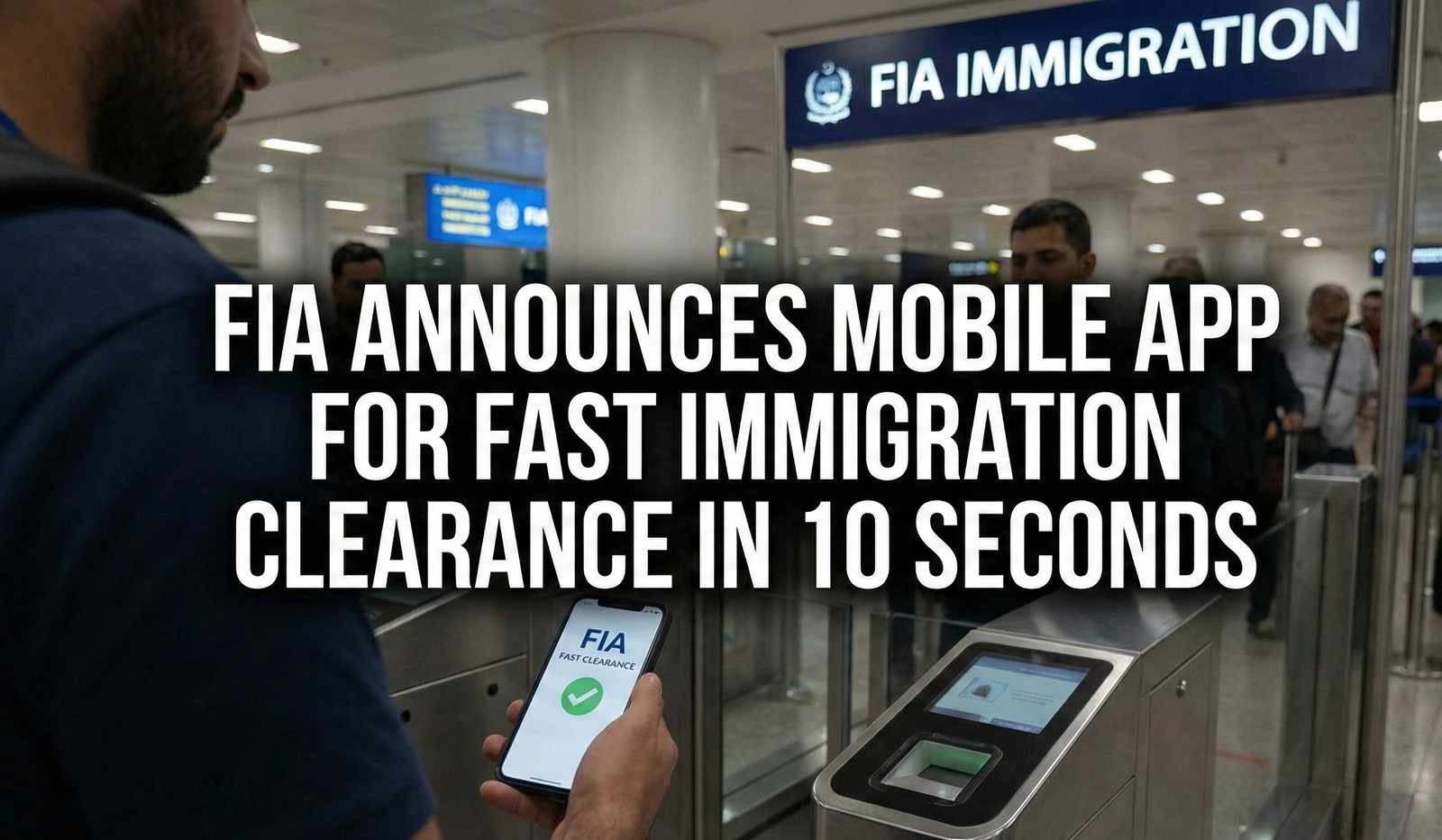
Pakistan’s immigration system entered a decisive phase of modernization today as authorities revealed a mobile-based solution aimed at cutting clearance time to seconds. The announcement matters now because airports face rising passenger volumes, tighter security expectations, and public pressure for faster, transparent services that match global standards.
Breaking context and the core announcement
The Federal Investigation Agency confirmed the launch plan for a new digital immigration platform designed to deliver clearance in as little as ten seconds. The agency shared the update during an official briefing in Lahore, outlining a phased rollout beginning in 2026 at major international airports. The initiative responds to long queues, manual bottlenecks, and inconsistent processing times that frustrate travelers during peak seasons.
The FIA leads the project in coordination with airport operators, technology partners, and federal stakeholders. Officials stated that the system will integrate identity verification, travel history checks, and biometric validation into a single mobile workflow. The platform, formally titled the FIA E-Immigration App 2026, will allow eligible travelers to complete pre-verification steps before reaching immigration counters, thereby accelerating on-site clearance.
Who, what, when, where, and why
The Federal Investigation Agency developed the system to modernize border control while preserving national security. The agency plans to begin pilot operations in 2026, starting at high-traffic airports and expanding nationwide after testing. Lahore served as the venue for the announcement, reflecting the city’s role as a policy and aviation hub. The objective centers on reducing congestion, improving accuracy, and delivering a predictable experience for citizens and foreign visitors.
Officials emphasized that the app complements, rather than replaces, immigration officers. Automated checks handle routine cases quickly, while officers retain authority to review exceptions. This approach balances speed with oversight, a priority the agency highlighted repeatedly.
How the app works in practice
The FIA E-Immigration App 2026 enables travelers to submit required information through a secure mobile interface. The system verifies passports, matches biometric identifiers, and cross-checks watchlists in real time. When travelers arrive at the airport, the app confirms identity through biometric validation, completing clearance within seconds if no flags appear.
Authorities described the workflow as intuitive. Users receive prompts, complete steps in sequence, and receive confirmation before approaching designated e-gates or counters. The process reduces manual data entry and limits human error, a frequent cause of delays in traditional systems.
Security and data protection
FIA officials addressed security concerns directly. They stated that the platform uses encrypted data transmission and government-controlled servers. Access controls restrict data visibility to authorized systems only. The agency designed the architecture to align with international best practices for data protection, ensuring confidentiality and integrity.
Moreover, the app logs actions for auditability. This feature supports accountability and deters misuse. Officials noted that existing legal frameworks governing immigration and data use remain in force, providing oversight and remedies where necessary.
Operational readiness and staff training
Successful implementation depends on people as much as technology. The FIA confirmed comprehensive training programs for immigration staff, covering system operation, exception handling, and customer interaction. Officers will work alongside the app during the transition, ensuring continuity of service.
Infrastructure upgrades form another pillar of readiness. Airports will receive connectivity enhancements, backup power solutions, and redundancy measures to maintain uptime. The agency plans contingency protocols to handle outages without disrupting passenger flow.
Benefits for travelers and airports
Travelers stand to gain the most immediate benefits. Shorter queues reduce stress and uncertainty, particularly for families, elderly passengers, and business travelers on tight schedules. Airports benefit from smoother throughput, improved punctuality, and better resource allocation.
Airlines also welcomed the initiative. Faster clearance supports on-time performance and reduces gate congestion. Industry representatives noted that digital immigration aligns Pakistan with global aviation trends.
Optional adoption and phased rollout
The FIA clarified that early adoption will remain optional. Traditional counters will continue to operate alongside digital clearance during pilots. This dual-track approach allows users to adapt gradually and provides time to refine the system based on feedback.
The FIA E-Immigration App 2026 will expand features over time. Authorities mentioned potential integration with airline check-in systems and travel advisories in future updates, while stressing that reliability and security come first.
International context and best practices
Many countries now use smart border solutions to manage growing travel demand. Pakistan’s move reflects lessons learned from international deployments, adapted to local realities. Experts observed that success hinges on user experience, resilience, and transparent governance.
Public response and expectations
Initial public reaction has been positive. Frequent flyers expressed optimism about faster processing, while civil society groups urged transparency and accessibility. The FIA committed to public awareness campaigns, tutorials, and help desks to guide users.
Strategic implications
Beyond convenience, the app supports broader policy goals. Efficient border management enhances tourism, trade, and diaspora engagement. Digital systems allow institutions to scale without proportional increases in staffing or physical infrastructure.
The agency framed the project as an investment in trust. Predictable processes and measurable performance strengthen confidence in public services. Officials pledged to publish metrics during pilots to demonstrate impact.
Looking ahead
As testing begins, scrutiny will intensify. The FIA E-Immigration App 2026 will face real-world pressures, from peak travel surges to edge cases. The FIA welcomed evaluation, stating that iterative improvements will guide nationwide expansion.
In summary, the announcement signals a clear direction: faster clearance, stronger safeguards, and a traveler-centric experience. If execution matches intent, the FIA E-Immigration App 2026 could redefine arrivals and departures across Pakistan.
Read Trusted Stories, Breaking News & In-Depth Blogs – Start Exploring ChalPakistan
Frequently Asked Questions
What is the FIA E-Immigration App 2026?
It is a mobile platform that enables rapid immigration clearance through digital verification.
Who is responsible for the app’s development?
The Federal Investigation Agency developed it with partner institutions.
When will the system become available?
Authorities plan pilots and phased rollout beginning in 2026.
Where will the app launch first?
Major international airports will host initial deployments.
Why did the FIA introduce this app?
The agency aims to reduce queues and improve processing efficiency.
How fast is the clearance process?
Officials state that clearance can take as little as ten seconds.
Is participation mandatory for travelers?
No, traditional counters will remain during early phases.
How does the app protect personal data?
It uses encryption, access controls, and government-hosted servers.
Can foreign nationals use the app?
Yes, the system supports citizens and eligible foreign travelers.
What benefits will airports see?
Airports can expect smoother passenger flow and reduced congestion.