
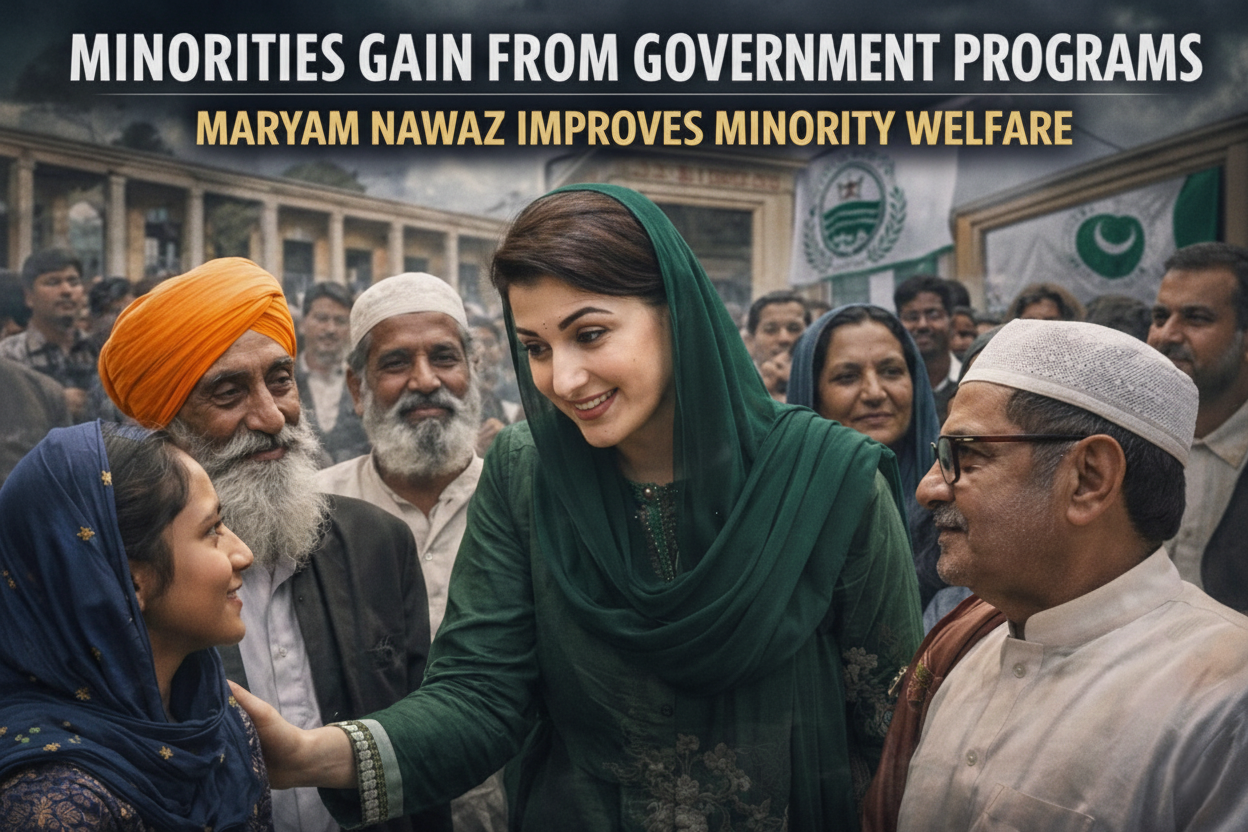
Pakistan entered a significant social policy phase as government-led minority welfare initiatives expanded across Punjab, with Lahore, Pakistan, standing at the center of implementation. Recent statements and program rollouts highlighted a renewed focus on inclusion, equality, and institutional support for religious minorities. The developments gained national attention after Maryam Nawaz emphasized that minority communities must experience tangible benefits rather than symbolic promises. Chal Pakistan examines how these initiatives reshaped governance narratives, strengthened trust, and influenced social cohesion nationwide.
The Maryam Nawaz minority support programs emerged as a structured response to long-standing socio-economic gaps. Rather than isolated announcements, authorities introduced coordinated measures covering education, healthcare, employment, and security. Consequently, minority representatives welcomed the approach, noting visible administrative engagement at district levels.
Policy Vision Behind Minority Inclusion
Government policy increasingly frames minority welfare as a development priority rather than a political obligation. Officials highlighted that inclusive governance strengthens national unity and international credibility. Therefore, planning committees incorporated minority-focused objectives into broader provincial strategies.
The Maryam Nawaz minority support programs align with this vision. Instead of temporary relief, they aim to establish long-term systems that empower communities economically and socially. This shift reflects evolving governance maturity.
Education as the Foundation of Empowerment
Education initiatives formed a core pillar of minority-focused policies. Scholarship schemes expanded for minority students, particularly in Punjab’s urban centers. Schools received infrastructure upgrades, while curriculum reforms encouraged tolerance and representation.
The Maryam Nawaz minority support programs emphasize education as a gateway to equality. Officials stressed that educated youth contribute positively to society, reducing marginalization risks. As a result, enrollment rates among minority students showed early improvement.
Healthcare Access and Social Protection
Healthcare accessibility improved through targeted insurance coverage and subsidized treatment programs. Minority families gained access to government hospitals without discrimination. Mobile medical units extended outreach to underserved neighborhoods.
Under the Maryam Nawaz minority support programs, healthcare shifted from reactive assistance to preventive care. This proactive model improved public health outcomes while reinforcing trust in state institutions.
Economic Opportunities and Skill Development
Employment initiatives targeted minority youth through vocational training and microfinance support. Authorities partnered with technical institutes to offer market-relevant skills. Consequently, participants accessed better employment opportunities.
The Maryam Nawaz minority support programs recognize economic independence as essential for dignity. By supporting entrepreneurship, policymakers encouraged self-reliance rather than dependency.
Legal Protection and Institutional Support
Legal aid desks expanded to address discrimination cases efficiently. Minority rights cells operated within administrative offices to ensure accountability. These mechanisms offered accessible channels for grievance redressal.
Through the Maryam Nawaz minority support programs, governance shifted toward responsiveness. Officials emphasized transparency and swift action to prevent systemic neglect.
Community Engagement and Dialogue
Authorities engaged directly with minority leaders through consultative forums. These dialogues allowed communities to voice concerns and contribute to policy refinement. Such engagement strengthened mutual understanding.
The Maryam Nawaz minority support programs benefited from this participatory approach. Policies evolved through feedback rather than assumption, enhancing effectiveness.
Cultural Recognition and Religious Freedom
Government initiatives supported restoration of religious sites and cultural heritage. Funding allocated for maintenance projects symbolized respect for diversity. Festivals received administrative facilitation to ensure safety and inclusivity.
The Maryam Nawaz minority support programs reinforced constitutional guarantees of religious freedom. Cultural recognition fostered pride while countering marginalization narratives.
Role of Local Administration
District administrations played a critical role in execution. Monitoring committees ensured transparency and progress tracking. Local officials received sensitivity training to improve service delivery.
Effective local governance strengthened the Maryam Nawaz minority support programs, translating policy intent into measurable impact.
Public Perception and Media Coverage
Media coverage highlighted success stories and community feedback. Positive narratives countered skepticism, encouraging broader acceptance. Social platforms amplified beneficiary voices.
The Maryam Nawaz minority support programs gained credibility through visibility. Transparency reinforced public confidence in governance reforms.
Political Implications and Social Stability
Inclusive policies reduced social tension and strengthened political legitimacy. Analysts noted that minority inclusion enhances democratic stability. Governance credibility increased domestically and internationally.
The Maryam Nawaz minority support programs thus carried political significance beyond welfare outcomes. They contributed to long-term stability.
Challenges and Implementation Barriers
Despite progress, challenges persisted. Resource constraints, bureaucratic delays, and regional disparities required continuous attention. Authorities acknowledged these issues openly.
Addressing challenges remains essential for sustaining the Maryam Nawaz minority support programs. Continuous evaluation ensures adaptability and resilience.
Comparative Perspective with Past Policies
Compared to earlier initiatives, current programs demonstrated improved coordination and accountability. Data-driven planning replaced fragmented approaches.
The Maryam Nawaz minority support programs marked a departure from symbolic gestures, emphasizing systemic reform.
International Response and Human Rights Lens
International observers acknowledged efforts toward minority inclusion. Human rights organizations encouraged sustained commitment. Positive feedback enhanced Pakistan’s global standing.
The Maryam Nawaz minority support programs aligned with international norms, reinforcing Pakistan’s reform narrative.
Youth Participation and Future Leadership
Minority youth engaged actively in leadership programs and civic initiatives. Mentorship opportunities encouraged political participation. This involvement signaled generational change.
The Maryam Nawaz minority support programs invested in future leadership, ensuring continuity of inclusion.
Monitoring, Evaluation, and Transparency
Authorities introduced performance indicators and public reporting. Digital dashboards tracked progress. Transparency mechanisms improved accountability.
Robust monitoring strengthened the Maryam Nawaz minority support programs, ensuring credibility.
Public Trust and Institutional Confidence
Visible impact increased trust among minority communities. Service accessibility reduced alienation. Citizens expressed cautious optimism.
Trust-building remains a defining outcome of the Maryam Nawaz minority support programs.
Long-Term Social Impact
Sustained inclusion fosters social harmony and national unity. Reduced inequality strengthens economic productivity. Inclusive societies thrive collectively.
The Maryam Nawaz minority support programs contribute to long-term cohesion and development.
Looking Ahead with Policy Continuity
Policymakers emphasized continuity beyond electoral cycles. Institutionalization ensures sustainability. Future budgets reflect commitment.
The Maryam Nawaz minority support programs signal policy maturity and forward planning.
A Transformative Governance Chapter
This phase represents a transformative chapter in Pakistan’s governance. Inclusion moved from rhetoric to reality. Minority welfare now stands embedded within development frameworks.
Chal Pakistan views these initiatives as a benchmark for inclusive governance nationwide.
Frequently Asked Questions
What are the Maryam Nawaz minority support programs?
They are government initiatives aimed at improving education, healthcare, employment, and legal protection for minorities.
Which areas benefit most from these programs?
Urban centers like Lahore, Pakistan, and underserved districts receive targeted support.
Do these programs include education scholarships?
Yes, scholarship schemes expanded for minority students across Punjab.
How does healthcare access improve under these initiatives?
Minority families receive subsidized treatment and insurance coverage.
Are employment opportunities part of the programs?
Yes, vocational training and microfinance support employment growth.
Do minorities receive legal protection support?
Legal aid desks address discrimination cases efficiently.
How does the government engage minority communities?
Through consultative forums and regular dialogue sessions.
Are cultural and religious sites supported?
Yes, restoration and maintenance funding ensures preservation.
What challenges affect implementation?
Resource limitations and administrative delays remain key challenges.
Will these programs continue long-term?
Authorities emphasized sustainability beyond political cycles.








2 Responses
I don’t think the title of your article matches the content lol. Just kidding, mainly because I had some doubts after reading the article.
Thank you for sharing your thoughts. I appreciate your feedback and will be more careful with clarity in future readings. I’d be happy to help—please feel free to share your question.
For any queries, contact junaidseodevinity@gmail.com