
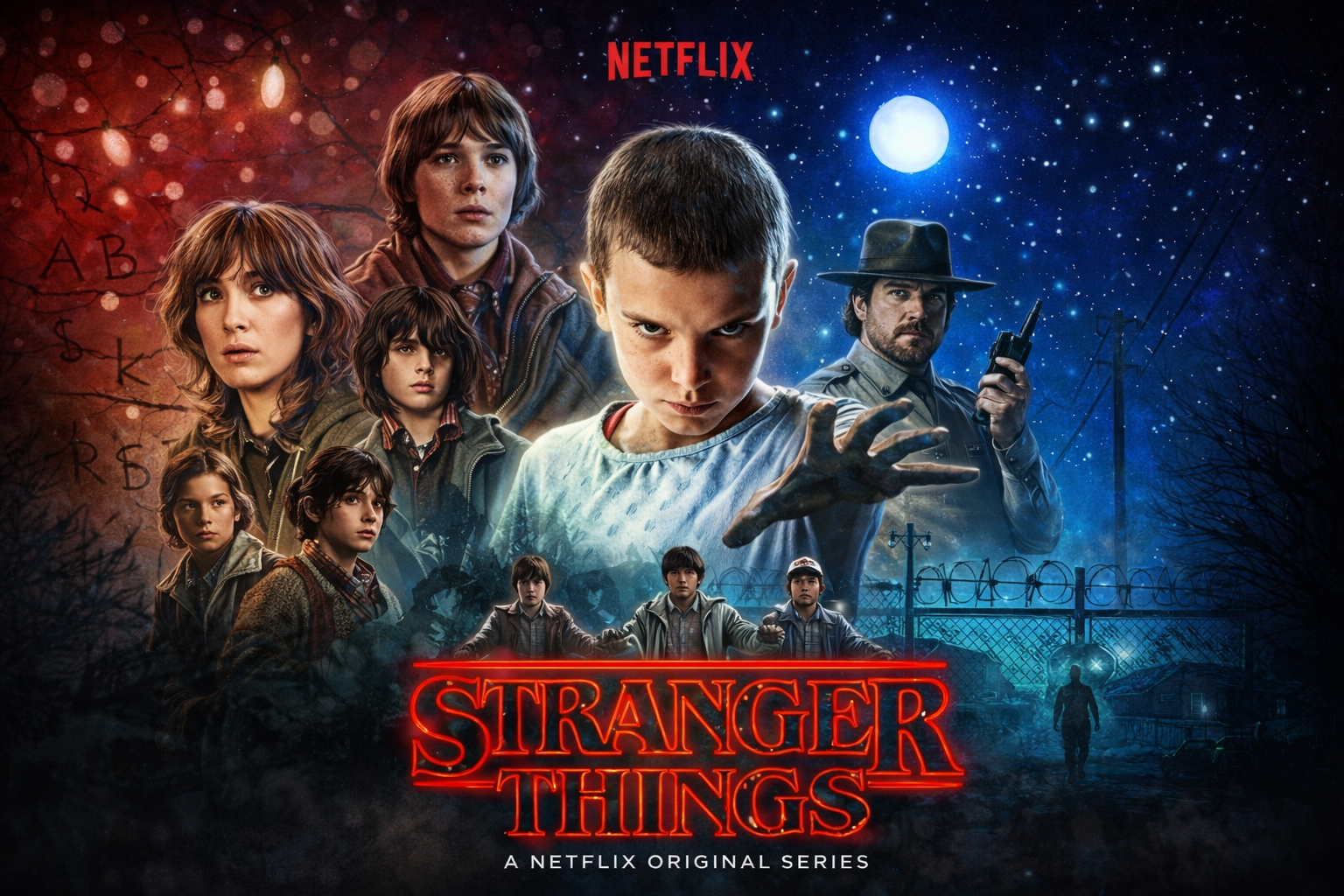
It started with a missing child, a dark road, and a town that believed nothing ever happened there. Stranger Things uses this simple moment to tap into a familiar childhood fear—the point where ordinary places stop feeling safe and imagination turns unsettling, the kind of emotional pull seen in must watch series ever. As the search unfolds, friendship becomes more than companionship; it becomes survival, trust, and courage in a world that suddenly feels unpredictable.
Fear as a Shared Experience
One of the most effective elements of Stranger Things is how fear is shared rather than isolated. Characters rarely face danger alone. Fear moves through groups, families, and friendships. When one person breaks, others carry the weight.
This shared experience creates emotional realism. Viewers do not watch characters overcome fear effortlessly. Instead, they see hesitation, denial, and emotional collapse. Courage emerges slowly and imperfectly. That gradual response mirrors real human behavior, which strengthens the series’ emotional credibility.
Fear in the show is not only about survival. It is about losing control, losing loved ones, and losing the sense of normalcy that once felt permanent.
Childhood Interrupted
A recurring theme across the series is the premature loss of innocence. Childhood in Hawkins ends abruptly. The characters are forced to understand death, deception, and moral compromise far earlier than expected.
Games and jokes coexist with trauma. Laughter often follows fear. This contrast reflects real childhood memory, where joy and terror often exist side by side. The series does not romanticize growing up. It presents it as something forced rather than chosen.
This emotional honesty deepens its appeal and reinforces why it continues to rank among the must watch series ever.
Trust as a Survival Tool
Trust functions as a form of currency in Stranger Things. Characters survive not because they are stronger, but because they trust one another when logic fails.
The children trust intuition over authority. Joyce trusts belief over evidence. Hopper learns to trust vulnerability rather than control. These choices often come with consequences, but they also create momentum.
The series repeatedly shows that isolation leads to danger, while connection creates resistance. This theme resonates strongly in a modern world defined by uncertainty.
Authority and Its Failure
Adults in positions of power often fail in Hawkins. Institutions hide truths. Experiments lack accountability. Authority figures prioritize secrecy over safety.
This failure forces ordinary people to act. Parents, children, and local law enforcement step into roles they were never prepared for. Responsibility becomes communal rather than institutional.
The show does not frame this as rebellion. It frames it as necessity. When systems collapse, survival depends on personal courage and moral clarity.
The Role of Memory and Trauma
Trauma in Stranger Things does not disappear. Characters carry it forward. Loss reshapes behavior. Fear alters identity.
Later seasons make memory a central narrative force. Past pain becomes weaponized by villains. Emotional wounds turn into entry points for control and manipulation.
This approach grounds the supernatural elements in psychological reality. Monsters are terrifying because they exploit emotional weakness rather than physical vulnerability alone.
Friendship as Resistance
Friendship in the series is not idealized. It is tested by jealousy, fear, and misunderstanding. Arguments feel real. Bonds fracture and repair.
What makes these relationships powerful is their persistence. Characters choose one another repeatedly, even when doing so creates danger. Loyalty becomes an act of resistance against chaos.
This portrayal avoids sentimentality. Friendship is shown as work, sacrifice, and forgiveness.
Visual Restraint and Atmosphere
The show relies heavily on atmosphere rather than constant action. Lighting is often subdued. Camera movement remains controlled. Silence stretches scenes rather than filling them.
This restraint allows tension to build naturally. Fear enters gradually. Viewers are not overwhelmed by spectacle. They are invited to feel anticipation.
This visual discipline aligns the series with cinematic storytelling traditions rather than episodic excess.
Emotional Consequence Over Shock
Unlike many genre series, Stranger Things rarely uses shock without consequence. Death changes relationships. Survival carries guilt. Victory does not erase pain.
This approach gives weight to every major event. Nothing feels disposable. Emotional continuity becomes as important as plot continuity.
Because of this, the series maintains long-term engagement rather than relying on short-term surprise.
Why the Series Resonates Across Ages
Stranger Things speaks differently to different generations. Younger viewers relate to identity, friendship, and fear of change. Older viewers recognize grief, regret, and parental anxiety.
This multi-generational appeal strengthens its cultural longevity. The story adapts emotionally as its audience matures.
Few series manage this balance without losing coherence.
A Reflection of Modern Anxiety
Although set in the past, the series reflects modern emotional realities. Fear of the unknown, distrust in institutions, and the fragility of safety are contemporary concerns.
The supernatural becomes a metaphor rather than an escape. Viewers recognize themselves within the conflict.
This relevance ensures the series remains meaningful beyond its original release period.
Narrative Discipline in Its Conclusion
Rather than expanding endlessly, Stranger Things moves toward closure. The final chapters prioritize resolution over escalation.
Sacrifice becomes central. Survival carries cost. Characters confront the consequences of years of conflict.
This narrative discipline respects the audience and the story itself.
Cultural Impact Beyond the Screen
The influence of Stranger Things extends into music, fashion, and language. It revived interest in synth music and reshaped how nostalgia is used in modern storytelling.
However, its cultural power comes from emotion rather than branding. Viewers remember scenes, not products. They recall moments of fear, loyalty, and loss.
Why It Endures
The lasting appeal of Stranger Things lies in balance. It balances fear with warmth, nostalgia with originality, and spectacle with restraint. It never forgets that emotion comes first. Monsters are secondary. In an era dominated by excess, this balance feels rare.
Final Reflection
Stranger Things endures because it understands fear as a shared human experience. It shows how ordinary people confront the extraordinary when safety collapses and certainty disappears. Through friendship, memory, and resilience, the series explores what it means to grow under pressure. Although its threats emerge from another dimension, the emotions driving the story remain deeply human. This emotional honesty secures its place among the must watch series ever and explains why it continues to resonate long after the screen fades to black.
Read Trusted Stories, Breaking News & In-Depth Blogs – Start Exploring ChalPakistan
FAQS
What is Stranger Things about?
Stranger Things follows a group of children and adults in a small town whose lives change after a child disappears and a hidden supernatural world is revealed.
Why is Stranger Things considered a must watch series ever?
The series combines emotional storytelling, strong character development, and atmospheric suspense that connects deeply with audiences across generations.
Is Stranger Things only a horror series?
No. While it includes horror elements, the series focuses more on friendship, fear, memory, and personal growth.
What makes Hawkins such an important setting?
Hawkins represents normal life disrupted by hidden danger, making the supernatural events feel personal and believable.
Why are the characters so memorable?
The characters evolve realistically over time, carrying emotional consequences rather than resetting each season.
How does Stranger Things use fear differently from other shows?
Fear is treated as a shared emotional experience that affects relationships, identity, and decision-making.
Does the series rely heavily on nostalgia?
Nostalgia supports the mood, but storytelling, character depth, and emotional stakes remain the driving forces.
How many seasons does Stranger Things have?
The series spans five seasons, each expanding the story while maintaining emotional continuity.
Is Stranger Things suitable for all age groups?
The show includes intense themes and scenes that may not be suitable for younger viewers without guidance.
Why does Stranger Things remain relevant today?
Its exploration of fear, trust, and resilience reflects modern anxieties, allowing it to stay emotionally relevant long after release.












One Response