By ChalPakistan, Lahore
In a cinematic landscape often driven by escapism, audiences walking into Haq (2025) expect something heavier, quieter, and far more unsettling. Framed through a Haq Movie Critical Analysis, the film signals early that it will not offer comfort or easy resolution. Instead, it positions itself as a reflective courtroom drama that engages with faith, constitutional law, and gender justice in a region where these forces frequently collide. Unlike spectacle-heavy classics often listed among the greatest movies of all time, Haq seeks impact through restraint and moral inquiry.
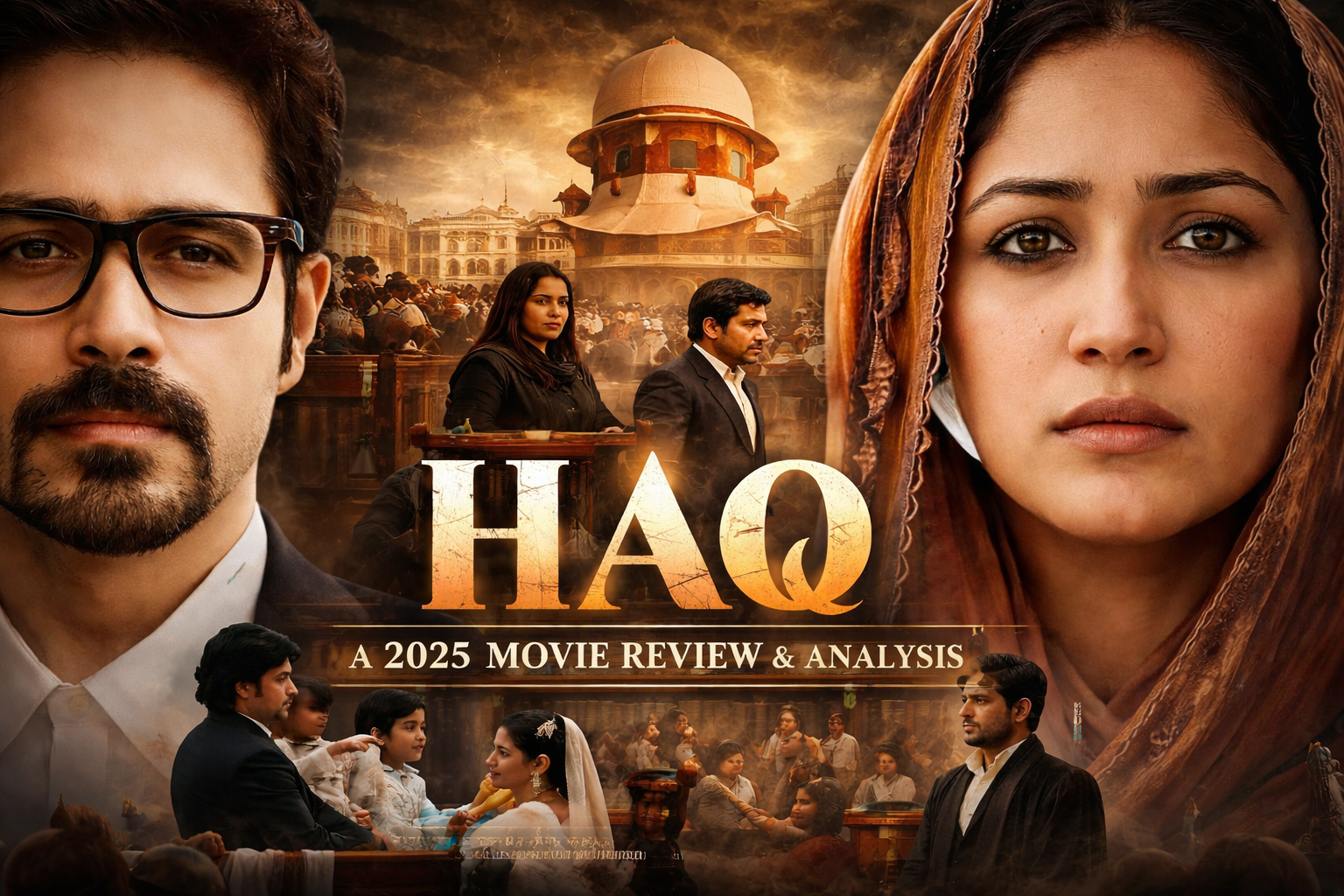
Directed by Suparn Verma, Haq is a Hindi-language Indian courtroom drama released theatrically on 7 November 2025. Starring Yami Gautam Dhar and Emraan Hashmi, the film arrives with both cultural weight and public scrutiny. Viewers familiar with South Asian socio-legal debates approach the film with an awareness of its real-world inspiration, while others arrive curious about how mainstream cinema can address women’s rights and religious authority without collapsing into propaganda.
This shared anticipation places a heavy responsibility on the film to remain grounded, honest, and credible an obligation it largely accepts through restraint rather than spectacle, a quality often found in socially conscious entries later counted among the greatest movies of all time.
The Real-World Echo Behind the Story
Although Haq is not a documentary, its narrative draws directly from one of India’s most consequential legal battles: Mohd. Ahmed Khan v. Shah Bano Begum. The case reshaped national discourse around Muslim personal law, constitutional equality, and women’s right to maintenance.
The film adapts this history through fiction, inspired by journalist Jigna Vora’s book Bano: Bharat ki Beti. This approach grants narrative flexibility while retaining moral and historical gravity. While many films aspire to recognition among the greatest movies of all time, few are willing to engage so deeply with unresolved legal and social wounds.
By prioritizing lived experience over legal exposition, Haq elevates the Shah Bano legacy from case law into human consequence.
Storyline Overview Without Spoilers
Set in 1970s India, the film follows Shazia Bano, married to advocate Mohammad Abbas Khan. Her seemingly stable domestic life fractures when Abbas abandons her emotionally and later returns with a second wife. Financial neglect follows emotional betrayal, forcing Shazia to return to her hometown with her children.
When Abbas fails to honor promised maintenance, Shazia played with measured restraint by Yami Gautam Dhar seeks justice through secular courts with the help of lawyer Bela Jain. In retaliation, Abbas invokes talaq-e-biddat (instant triple talaq), transforming a personal dispute into a constitutional confrontation.
Rather than relying on dramatic reversals, the narrative unfolds through persistence, exhaustion, and moral pressure. Courtrooms matter, but they never eclipse the personal cost of survival, setting Haq apart from courtroom spectacles often remembered among the greatest movies of all time for drama rather than realism.
Narrative Structure and Screenplay Choices
Written by Reshu Nath, the screenplay adopts an intentionally deliberate pace. Conversations feel unhurried, mirroring how real legal battles stretch across years rather than scenes. This realism strengthens authenticity but may challenge viewers accustomed to heightened courtroom theatrics.
Crucially, the script resists moral absolutism. Opposition is portrayed not as cruelty, but as conditioning shaped by fear, tradition, and institutional loyalty. This ethical complexity aligns the film with responsible social cinema, a category that frequently gains long-term recognition among the greatest movies of all time rather than immediate commercial success.
Characterization and Emotional Realism
Shazia Bano is not framed as a symbol but as a human being navigating fatigue, resolve, and uncertainty. Her emotional restraint avoids melodrama and reinforces authenticity. The performance communicates dignity through silence rather than speeches.
Supporting characters reflect systems rather than stereotypes. Family elders, clerics, and judges occupy morally ambiguous positions, illustrating how injustice often survives through compliance rather than malice. These layered portrayals deepen the film’s emotional credibility.
Performances That Sustain Credibility
Yami Gautam Dhar delivers one of her most controlled performances, resisting theatrical excess. Her portrayal invites empathy without demanding it. Emraan Hashmi, as Abbas Khan, avoids caricature, presenting entitlement shaped by selective tradition rather than outright villainy.
Sheeba Chaddha’s portrayal of Bela Jain grounds the film legally and emotionally, embodying institutional patience and quiet resistance. Collectively, the performances reinforce realism and thematic integrity.
Direction and Ethical Restraint
Suparn Verma approaches Haq with visible caution. The direction favors observation over accusation, allowing events to unfold without emotional coercion. This restraint is especially significant given the film’s subject matter and pre-release legal controversy.
By trusting the audience to interpret rather than react, the film preserves intellectual honesty and avoids reducing lived trauma into ideological spectacle.
Music, Sound, and Visual Language
The soundtrack is composed by Vishal Mishra, with background score by Sandeep Chowta. Music functions as emotional undercurrent rather than instruction. Silence is frequently more powerful than sound, especially during moments of isolation.
Cinematography by Pratham Mehta favors natural lighting and static framing. Domestic spaces feel confining, public spaces feel exposed, and courtrooms remain visually neutral observed rather than dramatized. This visual discipline supports the film’s ethical posture.
Justice as Experience, Not Abstraction
Justice in Haq is not presented as a legal endpoint but as a lived process. The film acknowledges faith as meaningful while interrogating interpretations that deny dignity. Shazia’s pursuit of maintenance becomes a pursuit of recognition and moral agency.
The Supreme Court ruling affirms her legal right, but the film’s deeper question remains unresolved: what does justice mean when survival itself requires resistance?
Controversy, Release, and Reception
Prior to release, Haq faced legal challenges from Shah Bano’s family regarding consent and portrayal. In November 2025, the Madhya Pradesh High Court dismissed the plea, affirming that privacy rights are not inheritable and recognizing the film as a fictionalized adaptation.
While the film underperformed theatrically, its Netflix release on 2 January 2026 marked a turning point. The film topped streaming charts in India and ranked second globally among non-English-language films, reinforcing how audience resonance—not box-office numbers—often defines the greatest movies of all time.
Final Evaluation
As a complete Haq Movie Critical Analysis, the film succeeds not by delivering verdicts, but by demanding reflection. It challenges authority without hostility and defends women’s dignity without spectacle. Its restraint, authenticity, and ethical clarity position Haq as a film whose legacy may grow with time much like the greatest movies of all time that are fully understood only in hindsight.
Read trusted stories, breaking news, and in-depth film analysis that values context over noise. Start exploring ChalPakistan for journalism that informs, questions, and reflects.
FAQs
Is Haq based on a true story?
The film draws inspiration from a historic legal case but adapts events and characters for narrative purposes.
Does the film criticize religion?
It questions authority and interpretation rather than faith itself.
Is Haq a courtroom drama?
Legal proceedings matter, but personal and social impact remains central.
Are there spoilers in this review?
No major plot details have been revealed.
Who should watch Haq?
Viewers interested in socially reflective and issue-driven cinema.
Is the pacing slow?
The narrative unfolds deliberately to maintain realism.
Does the film take a political stance?
It presents issues without overt alignment, encouraging independent thought.
How does Haq portray women’s rights?
It emphasizes dignity, autonomy, and moral agency.
Is the film suitable for international audiences?
Yes, its themes resonate beyond regional context.
What makes Haq distinct?
Its restraint, authenticity, and willingness to engage complex moral questions.