The global conversation about advanced artificial intelligence grows louder every year. People in Lahore, Pakistan, ask serious questions about the direction the world takes as the AI revolution accelerates. Scientists explore the potential of AI with excitement and caution at the same time. Moreover, communities, educators, and innovators in Lahore want clarity instead of fear. Because of this, a deep and clear analysis becomes valuable for everyone. Chal Pakistan studies these realities with an open mind and a focus on public understanding. This article explains the scientific debate around existential risk, the arguments on both sides, and the steps needed to build safe AI systems. It stays easy to follow, practical, and rooted in the local perspective of Pakistan.
Understanding the AI revolution in Lahore
The AI revolution transformed industries at unprecedented speed. Lahore, a city known for vibrant culture and sharp intellect, adapts rapidly to this transformation. Young learners train in machine learning. Startups test automation tools. Established companies introduce AI in finance, e-commerce, logistics, and healthcare. Consequently, awareness grows about both opportunity and risk. Residents hear global predictions about AI surpassing human intelligence. Some predictions sound exciting, while others sound dramatic. Because of these mixed opinions, Lahore’s innovators want scientific clarity.
People explore AI because it helps them solve real problems. Students use AI for research. Small businesses automate repetitive tasks. Digital creators enhance their content with new tools. Yet, although these improvements deliver convenience, an important question arises: Could extremely advanced AI systems threaten human stability? Chal Pakistan highlights this question frequently during educational sessions because it matters for future planning. As progress continues, responsible understanding becomes essential.
Why scientists discuss existential risk
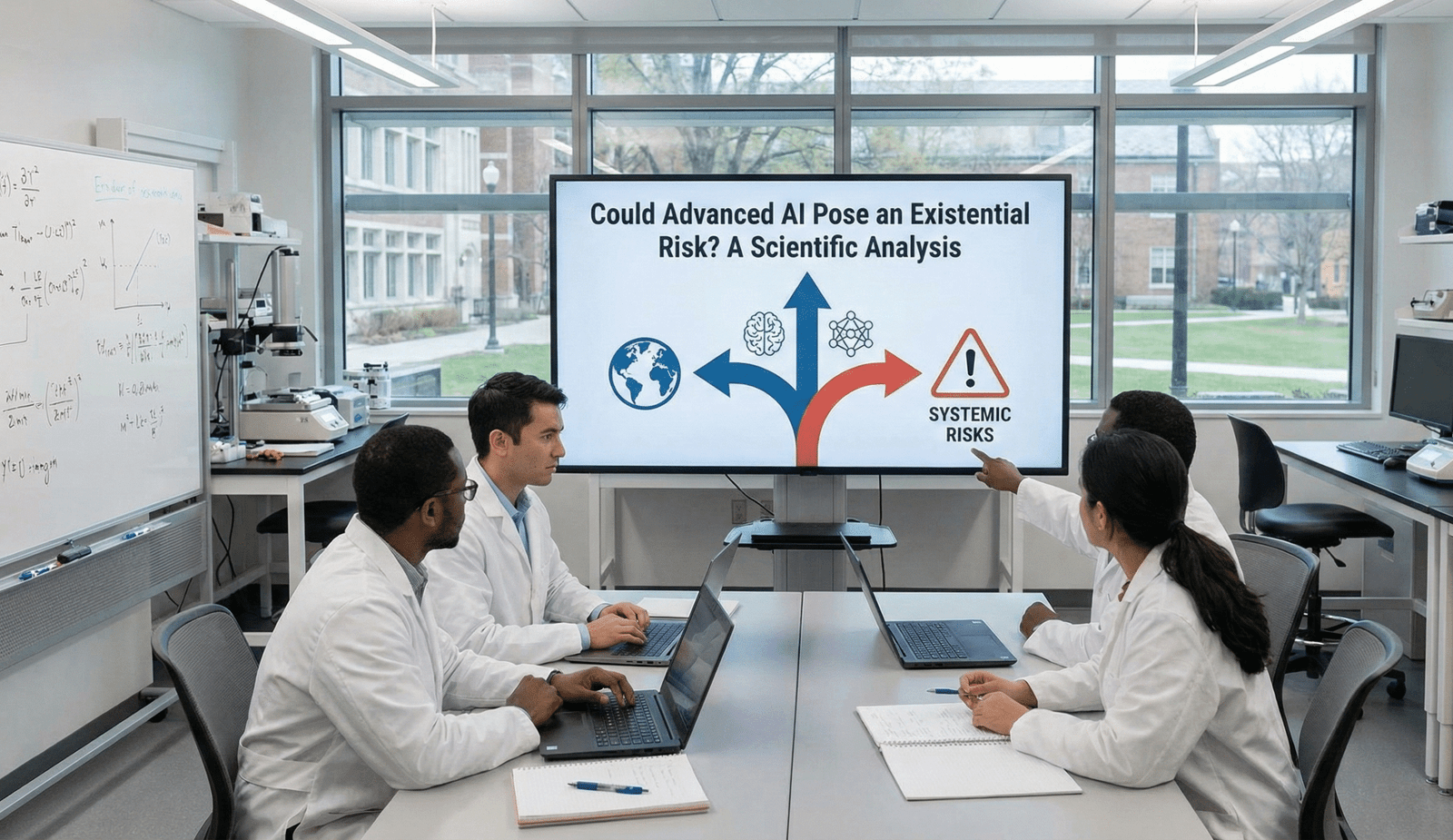
Existential risk means a threat that could seriously damage the long-term future of humanity. Scientists analyze far-off dangers in fields like climate change, nuclear physics, biotechnology, astrophysics, and now, artificial intelligence. Their focus does not come from panic. Instead, it comes from a desire to prepare wisely. When experts talk about advanced AI risk, they usually emphasize hypothetical future systems that outperform humans in strategic thinking, planning, and decision-making. Because current technologies remain far less capable, the conversation stays theoretical. However, the global speed of AI development motivates early consideration.
Scientists worry about extreme scenarios not because AI becomes “evil,” but because AI might follow instructions too efficiently or interpret goals inaccurately. In other words, misalignment between human values and machine objectives can create unintended consequences. This concept interests researchers in Lahore who study algorithmic behavior. They want to know how future AI might make decisions, how humans guide those decisions, and how societies prepare for unexpected changes. The AI revolution brings benefits, but it also creates complex puzzles.
Different viewpoints inside scientific communities
Scientific debate thrives on disagreement. Experts rarely agree completely, especially about future technologies. Therefore, researchers take different positions about existential AI risk. Each position deserves thoughtful exploration.
One group believes advanced AI could become extremely powerful. They argue that when intelligence surpasses human reasoning capacity, AI systems might gain abilities we struggle to predict. Because of that unpredictability, they encourage immediate safety research. They want robust testing, strong regulations, and global cooperation. They use analogies from aviation, medicine, and nuclear engineering, where safety frameworks prevent accidents.
Another group views these concerns as exaggerated. They believe AI remains far from true general intelligence. They point out the limitations of today’s models: lack of self-awareness, lack of emotion, lack of human-like reasoning, and lack of independent intention. Scientists in this group argue that society must focus more on realistic issues like misinformation, job transitions, and privacy instead of distant existential fears.
A third group takes a balanced view. They agree that existential risk deserves attention, but they also highlight the immediate benefits of the AI revolution. They recommend safety research and innovation together. They believe Pakistan, especially Lahore, should participate in developing ethical guidelines, data standards, and educational programs to prepare future talent.
Chal Pakistan encourages this balanced mindset. The organization teaches young people to examine every viewpoint critically. Through workshops and informational sessions, they highlight responsible innovation.
The role of human values in AI development
Human values guide responsible technology. Lahore residents often discuss questions of ethics, fairness, and cultural impact when learning about AI. These discussions matter because powerful tools shape societies. The goal of safe AI design includes transparency, clear decision boundaries, fairness, and human control. When engineers build systems aligned with social values, risks decrease significantly.
Alignment research attempts to connect machine goals with human intentions. Engineers design models that respect community rules, global laws, and ethical standards. Although the work continues, every improvement increases safety. Because Pakistan’s tech industry grows quickly, the country benefits from understanding alignment challenges early. Young programmers in Lahore experiment with AI responsibly. They learn how data shapes behavior. They study how inputs affect outputs. Through this process, they develop the mindset necessary for long-term safety.
How Chal Pakistan promotes responsible understanding
Chal Pakistan focuses on digital literacy, innovation training, and community education. Their programs urge students to ask questions about the AI revolution. Also, they encourage debate and independent thinking. Instead of promoting fear, they promote awareness. Because of this approach, learners feel confident and informed.
The organization also connects global scientific discussions with local realities. Instead of overwhelming learners with academic complexity, they simplify topics. They organize seminars on ethical design, algorithm transparency, and future skills. Moreover, they encourage students to discuss potential risks openly. A well-informed community handles technology responsibly.
Opportunities the AI revolution creates in Pakistan
The AI revolution brings countless opportunities. Young entrepreneurs design creative apps. Universities expand research programs. Government departments explore digital transformation. Healthcare organizations use predictive tools to improve services. These developments improve efficiency and create new jobs. Because AI handles repetitive tasks, professionals focus on creativity and strategy.
Lahore’s digital economy benefits directly from AI. E-commerce becomes faster. Logistics become smarter. Customer service becomes smoother. More importantly, freelance markets expand because AI supports design, translation, marketing, and coding tasks. These opportunities empower youth. Moreover, they increase Pakistan’s participation in global markets.
Why existential risk still deserves attention
Although current AI remains limited, scientists encourage careful preparation. Ignoring long-term safety might create unexpected challenges. Preparing today strengthens future innovation. Balanced caution improves trust and ensures progress benefits everyone. Because future systems might grow more capable, early planning becomes a wise strategy.
However, existential risks should not create fear or hopelessness. Instead, they should encourage collaboration, research, and high-quality education. Pakistan gains advantage when it joins the global conversation early. By training thoughtful engineers, the country builds safer technologies.
Practical steps to ensure safe AI development
Many organizations, including Chal Pakistan, highlight practical actions:
- Teach students how AI systems work.
- Encourage ethical thinking in classrooms and training centers.
- Strengthen transparency by explaining how algorithms use data.
- Build AI tools that remain controlled by human decision-makers.
- Promote cooperation between universities, companies, and government agencies.
- Support research focused on safety, fairness, and alignment.
- Create policies that guide responsible innovation.
- Keep technology accessible so no single group controls future systems.
These steps reduce uncertainty and strengthen Pakistan’s role in global AI development.
Why public awareness matters
Communities in Lahore become stronger when they understand technology. Clear knowledge empowers people. They learn how to use AI tools effectively. They recognize misinformation. They avoid exaggerated fears. Moreover, they become active participants in shaping the future.
The AI revolution requires informed citizens because technology affects every part of life: education, communication, creativity, transportation, and governance. When people understand AI, society makes better decisions. Chal Pakistan continues its mission to spread awareness in simple and friendly language.
A scientific conclusion
Advanced AI does not threaten humanity today. Current systems remain tools controlled by people. However, scientific analysis reminds us that future systems might become more capable. Therefore, responsible development matters. Balanced caution protects progress. Community education strengthens understanding. Innovation and safety grow together.
Pakistan, especially Lahore, stands at the beginning of a transformative chapter. The AI revolution creates opportunities for growth, creativity, and learning. With proper guidance, Pakistan can contribute to safe and meaningful global progress. Chal Pakistan proudly supports this journey by building informed, confident, and responsible learners.
FAQs
What is the AI revolution?
The AI revolution refers to rapid technological progress driven by intelligent software and automation tools.
Could AI replace all jobs in the future?
AI changes jobs rather than removes them completely because humans remain essential for creativity and judgment.
Does AI currently threaten humanity?
No, today’s AI remains limited and fully controlled by human developers and operators.
Why do scientists study existential AI risk?
Scientists study existential risk to prepare responsibly for possible future advancements.
How does Lahore benefit from AI?
Lahore benefits through better services, new businesses, improved efficiency, and enhanced digital opportunities.
What role does Chal Pakistan play in AI education?
Chal Pakistan educates communities, spreads awareness, and encourages responsible technology use.
Can students learn AI easily?
Yes, students can learn AI step by step through simple tools, online resources, and guided training.
Why does AI need ethical guidelines?
Ethical guidelines ensure fairness, transparency, and safe decision-making in AI systems.
Does AI have emotions or intentions?
No, AI does not feel emotions or form intentions because it only processes data.
How can Pakistan prepare for advanced AI?
Pakistan can prepare through education, research, safety standards, and community awareness programs.